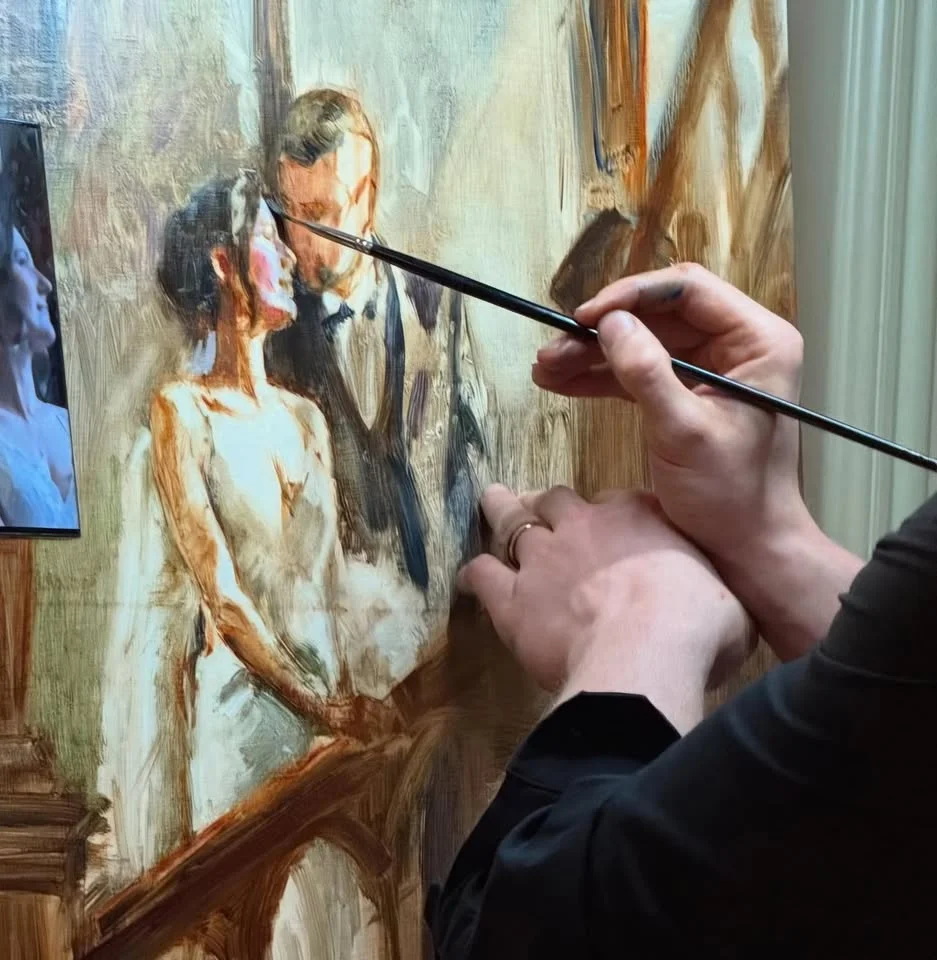
Category: Painters Guides

  • Stop Asking Couples How Much Detail They Want

    Stop Asking Couples How Much Detail They Want

    Stop Asking Couples How Much Detail They Want

    The most common question in commissioned wedding art might be the most expensive one in your enquiry process. Here’s what to ask instead.


    “How much detail would you like?”

    If you’re a live wedding painter or guest illustrator, you’ve probably asked this in almost every enquiry you’ve ever handled. It sounds professional. It sounds thorough. It sounds like exactly the kind of question a careful artist should ask.

    It’s also close to meaningless. And it’s quietly costing you bookings.

    Why Asking About “Detail” Stalls Live Art Enquiries

    Detail isn’t a dial a couple can turn up or down. It’s a handful of separate creative decisions wearing one coat, and almost nobody separates them out:

    • Should the painting be just the two of them, or the whole room?
    • Should the guests be recognisable people, or shapes and colour?
    • Does the venue need to be identifiably their venue, or is it a beautiful backdrop?
    • Is it the ceremony, the speeches, or the first dance?

    Answer those questions differently and you get two paintings that look nothing alike, take a wildly different number of hours, and land at very different prices. Yet an artist could honestly describe both of them as “highly detailed.”

    Now think about who you’re asking. A couple planning their wedding has almost never commissioned a painting before. They have no vocabulary for composition, rendering, or background treatment, and no way of knowing what the options even are. When you ask them how much detail they want, you’re handing the hardest part of the brief to the person least equipped to write it.

    So they say something vague back. You quote on a guess. They receive a number that doesn’t quite match the picture in their head, hesitate, say they’ll think about it, and often never reply again.

    They didn’t drop out because they didn’t want the painting. They dropped out because nobody turned a feeling into a decision quickly enough.


    The 3 Questions to Ask Every Wedding Art Enquiry

    The artists who convert best on our platform don’t ask about detail at all. They ask three narrower questions that a couple can answer instantly, with zero art vocabulary required:

    1. What moment would you like captured?
    The first kiss, the speeches, the first dance. This decides the entire composition, and every couple already knows their answer. It’s usually the moment that made them want a painting in the first place.

    2. Do you want family members in the background to be recognisable?
    This is the single biggest driver of hours, and therefore price. It takes a couple half a second to answer, because nobody is unsure about whether they want their grandad in the painting.

    3. Does the venue need to be recognisable, or is it a backdrop?
    Architectural accuracy, the stonework, that specific window, the marquee they spent months choosing, is hours of work. A soft suggestion of a setting is not. Couples who’ve fallen in love with their venue will tell you immediately.

    Three quick answers, and you have a real brief. A quote that matches expectations before it’s even sent. A couple who feel understood rather than interrogated.


    Why This Simple Switch Converts More Clients

    Most lost enquiries aren’t a persuasion problem. They’re a specification problem wearing a persuasion costume.

    When a couple hesitates after receiving your quote, it’s rarely because the price is wrong in the abstract. It’s because they can’t picture what the price buys. Vague brief in, vague quote out, hesitation follows.

    The three questions close that gap at the very start of the conversation. Your quote arrives as confirmation of something they’ve already imagined, not a number they have to interrogate.

    There’s a second effect, too. Asking specific, confident questions signals that you’ve done this many times before. “How much detail do you want?” puts the burden on them. “What moment would you like captured?” tells them they’re in experienced hands. In a premium purchase, that feeling is half the sale.

    (Related reading: Learn how to price the answers once you have them in our complete guide to live art pricing.)


    Putting It Into Practice

    Here are three ways to build this framework into your enquiry process today:

    1. Ask the three questions in your very first reply. Speed matters enormously in wedding enquiries, and a fast reply containing three easy questions keeps a warm lead moving. A fast reply asking “how much detail do you want?” stalls it.
    2. Quote against the answers, not around them. “Based on the first dance, with your parents and grandparents recognisable in the foreground and the orangery in the background, here’s what I’d suggest” is a quote a couple can visualize. That’s what gets deposits paid.
    3. Show, don’t describe. If you have two paintings in your portfolio that answer these questions differently, one intimate couple-only piece and one full-room scene with recognisable guests, send both. The difference explains your pricing better than any paragraph ever will.

    (Check out our guide on building a portfolio that wins your first booking to streamline your visual assets.)


    The Bigger Principle

    This isn’t really about the word “detail.” It’s about a habit worth auditing across your whole enquiry process: anywhere you’re asking a couple an abstract question and treating their vague answer as a specification, you’re creating a place for the booking to stall.

    Couples don’t know how much detail they want. They know what moment mattered. They know whether grandad should be in the painting. They know whether the venue was half the reason they said yes to the date.

    Ask them the questions they can actually answer, and the brief, and the booking, takes care of itself.


    Ready to grow your creative business?

    Thinking about making live wedding art a primary part of your practice? Read our full step-by-step breakdown on How to Become a Live Wedding Painter.

  • 6 Things to Know Before Starting Live Wedding Painting

    6 Things to Know Before Starting Live Wedding Painting

    What does a Wedding painter do?

    As a live wedding painter it is your duty to capture a couples vision and display it onto canvas. Therefore, the build-up to the wedding taking place is crucial for you and the couple to agree on the styling, capturing moments, and any background imagery they wish to stand out. To help you get started we have broken down some key questions to ask during the build-up, ensuring you are able to provide them with the artwork they envisioned.

    1)What Style Of Painting Would They Like?

    Most wedding couples will choose their preferred artist by looking at their portfolio and then pick the artists with the style that fits their criteria. As an artist you will most likely have one proffered style or maybe, you are talented enough to specialise in a few. If you do specialise in a few, the first step is to identify which one the couple would prefer for their special day. This ensures there are no surprises later down the line for both you and the couple. 

    2) What Colour Scheme is The Wedding?

    Once the preferred style has been established, you will need to identify the colour theme for their wedding to know which paints to take with you. Outlining the colour theme and the décor allows you to build up your colour palette, and choose what brushes you will need. It also gives you time to visualise the painting itself and decide whether you will need to mix/blend any colours to get the desired effect.

    3) Who Are The Main Subjects Of The Painting?

    This may seem obvious but if you are completing several portraits throughout the evening then the couple may have specifications about what they want in each. The couple may want you capture the background in certain portraits, themselves in others or focus on the entire wedding party as a whole. Asking even the simple questions removes any worry or doubt later down the line.

    4) What Specific Moments Do They Want Capturing?

    This will blend into asking the couple who the main subjects are as they will also identify what areas of focus they would like. Typically, you will be capturing the most important moments such as the first kiss, first dance, exchanging of the vows or the cutting of the cake. Knowing exactly which moment the couple would like capturing will allow you to plan and position yourself in the best possible way to capture each feeling and emotion.

    5) Are There Specific Size Requirements For The Painting?

    The size of the painting will most likely determine how many pieces of art you will complete throughout the evening. Some wedding couples may only want you to focus on one moment created on a large canvas, whereas others may want a few smaller portraits. This will also help you calculate the amount of paint you require along with what easel size to take with you.

    6) Do They Have A Specific Budget In Mind?

    Organising a wedding requires a lot of forward planning, so couples are going to have a budget for each aspect of their wedding. It will be beneficial to offer multiple wedding packages, so couples have a range to choose from depending on how much they want to spend. These packages don’t have to be fixed in price they may be subject to change, but this will have to be reflected in the price. Couples may want a bespoke package creating to fit their budget. All of this can be determined during the initial conversation to come to a conclusion which suits all.

    There will be more questions but these initial 6 will give you a better understanding of each client’s vision, allowing you to build the framework to provide them with a piece they will cherish forever. We hope we have been able to provide you with good foundations to build upon throughout your live wedding painting career.

  • What is Live Wedding Painting?

    What is Live Wedding Painting?

    Live wedding painting is a unique technique artists use to capture someone’s special moments during their wedding ceremony.

    This style of painting is a very personal and amazing way to capture a couple’s wedding day which few artists are aware of, and even fewer offer as a service. This is because live wedding painting is a relatively unknown art technique and many artists don’t know where to begin.

    To help artists understand this process we have described the key features of live wedding painting, offering a breakdown of the typical process a live wedding painter takes from start to finish. 

    Typical features

    Live wedding paintings typically have 3 common features:

    • They are portraits of a couple’s special moments, such as their first kiss or first dance.
    • The portrait is captured on canvas, in a painting style unique to their chosen artist.
    • The portrait is completed live during the wedding ceremony, which is taken home by the couple at the end of the night.

    Although these are the 3 common features of a live wedding painting, they aren’t a requirement. Therefore, it doesn’t mean every live wedding painting must be a portrait, or that you can’t add your own unique flair to them.

    Painting focus

    As an artist you may specialise in capturing a building’s decor and ambiance, which may appeal to couples whose wedding venue is very special to them. Similarly, if you specialise in creating illustrations from words you could immortalise a couple’s wedding vows for them to display in their home and forever cherish.

    Although being able to paint portraits will increase your favorability amongst couples, it doesn’t mean this is the only style you have to offer.

    Painting style

    Whilst most couples may want their special moments captured in a painting, others may prefer you to use a different medium such as sketching using pencils/pens or ink. Utilising different art mediums will allow you to appeal to more couples, especially those who have very specific requirements.

    Painting time limits

    The style of the artists usually determines how many portraits are completed during the wedding ceremony. So, it’s fair to say that not all portraits will be completed in the short time of 8 hours. Couples wanting a realistic portrait should expect that the artist will have to finish the live wedding painting back at their studio to add all the small details which bring the painting to life. Whilst others may offer a faster style which allows them to paint quicker, and therefore complete paintings during the ceremony, it’s certainly not a requirement. 

    Live wedding painting timeline

    Now that we understand the main aspects of a live wedding painting it’s time to explore how they take place. We would like to start at the very beginning to help those at the very start of their journey.

    • The couple matches an artists style with their vision and commissions them to paint at their wedding.
    • The couple and artist identify important details of the live wedding painting such as; the painting setting, focus points, date/time of the wedding and last but not least its location. Checkout our in-depth guide ‘what to know before starting live wedding painting
    • The couple books artists using theweddingpainters.com and the date is set.
    • Artists then prepare their equipment ready for the event. To help with this checkout our guide ‘what equipment do I need’ 
    • Occasionally artists will speak with the wedding venue to gather details on layout and where special moments will take place in order to plan where they will set up.
    • Travel arrangements are made such as booking hotels and arranging transport.
    • On the day the artist should be prepared and arrive a couple of hours early to set up. If you’re just getting started use our guide ‘steps to take when painting at a wedding’ to help.
    • Note – Position yourself in the best location to capture the moment but also not obstruct the view of the guests.
    • Tip – Some artists paint the background before the moment arrives to focus all their effort on the main focus point; the couple!
    • Paint during the moment and engage with guests throughout (take photographs to be able to complete more detailed features later on after the moment has passed).
    • If you offer guest portraits most offer these  on a first come, first served basis, unless you have already discussed with the couple who you are going to paint.
    • Take the painting to your studio to complete if finalising is required.
    • Note – The couple should be aware if they are receiving the finished pieced during their ceremony or not.
    • Lastly framing and produce prints from the artwork if this is an option you provide.

    One thing we forgot to mention here is to have fun, trust your ability and talent as this will be the start of a very exciting and rewarding career.

    Can anyone become a live wedding painter?

    Yes! Anyone can become a live wedding painter however there are a few requirements you must meet ‘how to become a wedding painter’ guide. If you want to become a live wedding painter and join our amazing community of live wedding painters then please use this link:https://theweddingpainters.com/join-us/. It’s free to signup, and you will be part of a growing and committed community of live wedding painters, ranging in experience level from beginner all the way to professional.

  • What is a Wedding Illustrator?

    What is a Wedding Illustrator?

    A wedding illustrator is an artist who brings a unique form of live art to your special day, creating charming, real-time portraits of you and your guests. Unlike traditional wedding painters, wedding illustrators typically work on smaller canvases, often A6-size which allows them to produce multiple portraits quickly. Depending on their style and medium, a skilled wedding illustrator can create anywhere from 3 to 10 portraits every 30 minutes, which can be handed out as personalised keepsakes throughout the event.

    The style of these portraits varies widely, from detailed renderings to quick sketches or playful caricatures. Wedding illustrators typically use a range of tools, including pens, watercolours, pencils, or even digital devices to bring these portraits to life. Each illustration adds a special and unique touch to your wedding day, creating a blend of entertainment and artistry that leaves a lasting impression.

    How much do live wedding illustrators cost?

    Hiring a live wedding illustrator typically costs between £250 per day to £200 per hour, though prices can vary based on factors such as the size of the illustrations, the level of detail, the artist’s skill and experience, and the chosen style. Additional costs may include travel, accommodation, and other expenses like meals. It’s important to consider these variables when budgeting for a live illustrator at your wedding.

    How do you get into it

    Many wedding illustrators start with a natural passion for doodling and drawing, often from a young age. While some may pursue formal education in art, college or university training is not a requirement. Many begin by illustrating wedding photos for family and friends, gradually honing their skills and developing a unique style.

    Once the passion has built its time you secure your first live event. Securing your first live event can be daunting, one which you’ll never feel ready for, but it’s a crucial step in building your career. To begin you must market your services effectively whether through social media, a personal website, or dedicated platforms like TheWeddingPainters.com. Dedicated platforms can be particularly beneficial for newcomers as they offer affordable marketing, website exposure, and the chance to build a reputation from the start. Once you’ve booked your first event, ensure you have the necessary equipment such as illustrating tools, a foldaway table, an easel, and a display area for your artwork. With these in hand, you’re ready to bring your art to life at weddings.

    Are wedding illustrators worth having at your wedding?

    We believe a live wedding illustrator is a brilliant addition if you’re looking for something unique and memorable. This service not only entertains your guests but also provides them with a personalised gift to take home; a cherished keepsake of your love. Wedding illustrations offer a more personal and affordable alternative to live wedding paintings, adding an artistic flair that goes beyond the standard photo booth experience. Your guests will love the thoughtful touch, and you’ll create lasting memories of your special day.

  • Essential Steps For Brush Care.

    Essential Steps For Brush Care.

    To ensure your brushes perform at their best it is essential that you clean them properly. This may not come as a surprise, but it is a crucial step that is often neglected. As with any detailed craft keeping your equipment clean can be a tedious task. However, there are several easy steps you can take to ensure your paint brushes are both cleaned properly and stored correctly after each use.

    • Identify each brush part
    • Clean your brushes as soon as possible 
    • Identify the paint used 
    • Use the correct cleaning technique
    • Store your brushes correctly

    Identify each brush part.

    First we need to identify the three different parts of your brush – the bristles, the ferrule and the handle. Each will need specific care.

    • Bristles – These can be both natural or synthetic and each can be cleaned using the same detergent, you just have to be mindful that the cleaning technique will differ. Natural bristles are made from animal hair or fur and care should be taken when cleaning as they are more delicate than synthetic bristles which are usually made from nylon. Synthetic bristles will be more durable and break less.
    • Ferrule – This is the metal part of the brush that holds the bristles to the handle. This can be cleaned using most cleaning supplies; it is just essential to dry afterwards to avoid corrosion. Lower grade brushes will have thinner metal so take care not to deform this during cleaning.
    • Handle – The handles are usually made from either painted or varnished wood or hardened plastic. These are the easiest to clean and should be cleaned using wipes as you paint to ensure you don’t get it on yourself.

    Clean your brushes as soon as possible.

    It can be difficult mentally to clean your brushes straight after painting as it can be a laborious task. However, for the best results this is the recommended procedure as it doesn’t give the paint time to dry, which would require more rigorous cleaning. If you are to leave the paint to dry, it may be too difficult to remove therefore resulting in the brush being thrown away. Sometimes you can soak the brush in soap and water or use cleaning solvents to try and dissolve it, but even then it may be too late.

    Identify the paint used.

    Correctly identifying the paint is crucial as each paint has its own solvents that are to be used for cleaning. 

    Water-based paints or acrylics are the easiest to clean as you can simply use soap and warm water as your solvent. You can use regular dishwashing soap or purchase a specialised soap provided by most art manufacturers. This is also the least harsh solvent which will not damage your bristles or your hands as you are cleaning.

    Oil-based paints require a stronger solvent to clean which is typically turpentine or some kind of mineral spirit. As these are harsher than water and soap they can, over time, cause brittleness and breakages in the bristles of the brush. A good tip to prevent this is to clean with warm water and soap after the brush has been cleaned with solvents. For this cleaning method you can leave the brush soaking in the solvent or rub it through, take care to wear gloves during this process to protect your hands.

    Use the correct technique.

    Again another neglected step as having the proper cleaning technique can mean the difference between brushes being damaged or not. It is advised to clean brushes one by one and to perform strokes through the container holding the solvent (whatever the solvent being used). You can also buy specific brush cleaning jars which will separate out the solvent and the paint residue. Avoid pushing down hard on the brush as this will deform or break the bristles causing the brush to perform badly afterwards.

    Store your brushes correctly.

    Storing your brushes incorrectly can drastically reduce the lifespan of your brushes. Storing them with the bristles facing down can cause them to deform and break deteriorating. Attempt to dry the brushes off as much as possible before storage and ensure the bristles are pointing upwards to preserve their shape. Leaving the brushes wet can also cause the wood to swell, thus damaging the handle. This can also lead to the glue holding the bristles in place to come loose.

    Conclusion.

    Following these steps will make your life as an artist or live wedding painter easier and will ensure your brushes last as long as possible. It will also save headaches in the future when you come to reuse your brushes. It also saves money which would otherwise be spent on buying replacement brushes. Following the manufacturer’s guide provided with the paint brushes can also give you more specific cleaning procedures not mentioned here.

  • How To Price Your Art

    How To Price Your Art

    How to charge for your painting

    As an artist your main focus is creating masterpieces out of nothing using your creative genius, and we can bet you can probably do this blindfolded by now. You have spent countless hours perfecting your craft in such a way that you’re ready to start making a lucrative career from it. This brings upon the most daunting part of this process, pricing your artwork.

    Pricing

    Pricing is a laborious but necessary task, and one that most would prefer to avoid. However, if you’re going to become a successful artist this is a vital part of the process. Determining the price is a personal task as you are critically evaluating your own skills and comparing those to others on the market. So it’s a fine balance finding a price that is both representative of your work and acceptably to customers.

    This is especially important at the beginning of your career as you need to build up your reputation, have an eagerness to make sales, but you don’t want to sell yourself short.

    There are a few different ways you can start selling your artwork whether it be priced per piece, by the hour or by size there are several options. We have created a guide to help you price your art and hopefully, kickstart your career by doing the boring work for you.

    Don’t Undersell Your Talent

    The fastest and most surefire way to burn out is to overwork and undersell. It’s understandable to keep your prices low at the beginning as you build a customer base and get your name out there, but you don’t want to undersell yourself to the point where you can’t afford to live. Creating masterpieces isn’t cheap. Good materials cost money, studio space is expensive and so is travelling to the wedding venue.

    Research, research, research!

    Unfortunately, there isn’t one art pricing guide that suits everyone but, thanks to the internet, we now have access to everyone else’s artworks (as long as they’re online) which makes our job a lot easier. All you have to do is start looking for artists who match your style, experience level, geographical region and current market price; it could be that demand for unique artwork is high which correlates to higher pricing. 

    By comparing all these different factors from an artist in a similar situation will give you a better starting point rather than starting from scratch. Just make sure you give an honest evaluation of your own work, as it’s easy to add sentimental value which won’t be reflected from a customers’ standpoint. You could even reach out to other artists and ask for some tips and reasons for their pricing. Being honest with people is the best way to get the answers you are looking for.

    Charge per hour

    If you are pricing your work by the hour you need to determine the £/ph that you require to live then work up from there. The average hourly rate for the UK; location will have an effect, is £16.30ph. If this is your preferred method you will need to be diligent when recording how long a piece of artwork takes, then factor in materials and travel costs on top. This can be a good starting point as it’s easy for customers to evaluate an hourly rate compared to experience based pricing.

    The important thing to know when charging hourly for a live wedding painting is the time you’re going to spend at the venue. This will need to be discussed with the couple beforehand and, a few appointments may be required to finalise the timing. This isn’t taking into account any touch up or extra work required for completion afterwards. So be sure to always be transparent with couples, and ensure you keep a detailed record of time spent on each piece. This will help you provide the couple with the final price. It’s important to quote fairly accurately, as it would be very uncomfortable to have under or overcharged drastically.

    Charge per artwork

    Alternatively, you can charge per piece of artwork. For this method to work you have to be meticulous when working out the cost of materials and travel arrangements, as these can have a big impact on your profit margins. These skills will get better with time which is why this method is usually adopted as experience grows. However once you have all the raw materials totalled up it’s time to add on your work cost. Try to be as subjective as possible and remove any emotion when calculating this cost, as sentimental value can cause you to overvalue your work. Depending on the size and complexity of the artwork may depend on how much you add onto the base price to give yourself enough room to run over should it take longer than expected. 

    This is indeed a balancing act but once perfected opens up many opportunities. This style of pricing is very well suited to the wedding industry for several reasons. It allows you to create package deals, give discounts and much more to entice customers in. It also allows couples getting married to factor in the price for your masterpieces straight away, as charging per hour might not be suitable for couples working to a tight budget.

    Separate feelings from facts

    This one is probably the hardest aspect of pricing. It’s easy to add sentimental value onto artwork which you have created, but it’s much harder convincing a customer. Artists will always value their own work higher than others because of all the time, creativity and emotion put into each piece. Taking a step back and pricing any work on it’s physical attributes; time taken, material costs and size, is the only way to overcome this issue. If a mark-up price is to be added this needs to be linear as well, such as a 20% increase in price for a larger portrait.

    Separating feelings from facts is much easier to do if you are pricing per artwork rather than per hour. This is because the more time an artist spends on a piece, the more sentimental value and emotion it holds. Whereas pricing per artwork forces you to generate the cost before any work is conducted. Locking you into a mutual contract, removing any feeling which may inflate your price. 

    Of course feelings are always going to be felt no matter what, it’s just how you manage them that makes the difference. The same is to be said for live wedding paintings, being part of someone’s special day is going to create an emotional bond between you and the painting. You just have to remember you are there to provide a service. If you ask us, there is no better service than capturing a couple’s love on canvas, right before their very eyes.

    Create prints of your artwork

    You don’t have to generate all of your income directly from the painting, there are other directions you can take. One great one is to create prints from your original pieces of artwork for buyers to share out amongst their friends and family. Though a print may not be the original artwork, it can still hold the same emotion, quality and be produced in a decent size. This allows customers who have had a portrait from you to share it, giving you free publicity and getting your name out there.

    This would be especially useful where portraits are conducted such as graduations or weddings. Where the original owner of the artwork can provide the prints to all of their loved ones who may either want one, or may have not been able to make the special occasion. This also gives you the option to offer discounts to anyone who purchased a print from you, should they wish to have an original art piece created. The more streams of income you can think of for your artwork the better!

    Be transparent and confident with your pricing

    Clearly stating your hourly rate or price per piece builds a level of trust right away with the customer, even before any conversation has been had. Of course, there are factors that may result in the price increasing, such as additional requests from a customer and travel, but it’s easy to be transparent on these two. Telling customers on initial contact that these items are not included in the price; if they aren’t, is always the best way to avoid nasty surprises later down the line. 

    Additionally, if you hate talking about money and would rather avoid any uncomfortable conversations later on it helps to lay all your cards on the table straight away. It also gives the customer time to evaluate the costs and decide whether it fits their budget. Be mindful that you will always get customers telling you the price is too high, just be ready with a definitive answer explaining your reasoning. Not everyone will go for your artwork and some will blame the price, lowering your prices just because someone disagrees can be a sure fire way to run yourself out of business.

    Make a start

    It can be daunting making a start, but everyone has to start somewhere. Remember even the professionals were once amateurs. So, whether you have been producing art for several years, have just started or have decided you want to turn your passion into a career. Remember to do your research, take time mapping out your pricing model whether it be hourly or per piece, and most importantly enjoy the process.

  • Steps To Take When Painting At a Wedding

    Steps To Take When Painting At a Wedding

    Creating artwork will be second nature to you by now but performing under live conditions can change the dynamic. Preparation beforehand is key but ensuring you are the right mindset will also just as important. If you have been commissioned to paint at a wedding there are several steps you can take to ensure your masterpiece is a success.

    1)Gather Reference Material

    This can be done using many different forms of reference material such as photographs of the people attending or the venue itself. Even sketches of the style or theme of the wedding will help you to generate an image in your mind to deployed on the big day. Gathering reference material can be completed on the day of the painting if you are scheduled to arrive before any guests to take photographs of the venue. All of this material will help you accurately depict the people, venue, décor and small details of the wedding that will make your artwork stand above all others.

    Learn More

    2)Sketch Out The Composition

    Before painting begins it can be a good idea to first sketch the outlines to capture the moment before the settings change. This can be especially useful if you are new to live wedding painting and aren’t yet familiarised with the speed at which you should paint at. It will also help with the placement of various elements of the painting such as background settings to ensure that the moment was capture as true as it could be.

    3) Begin Painting The Background

    Starting with the background allows you to layer the more important features over the top embellishing them more. This will also be the most static aspect of the painting which will make painting it easier and quicker. As you will always have access to the background regardless whether anyone is there you will always be able to revisit it to make minor adjustments.

    4) Add In The Figures

    Naturally painting in the figures will come next, starting with the main subjects, whether that be the bride and groom or the wedding party as a whole. Make sure to pay attention to the poses, expressions and clothing of the figures to ensure they are accurately depicted. For some portraits there may only be static features such as the wedding cake, making it much easier.

    5) Add Small Details And Final Touches

    Once all the main important aspects of the portrait have been completed it’s time to add the smaller more intricate details to really make it pop. Smaller details can include flowers or decorations, details that can take time to add but turn out to be important touches. Final touches can include and highlights or shading required to really bring the portrait to life.

    6) Take A Step Back And Review

    This is most likely to be the final step of the process and that’s taking a step back and looking at the portrait as a whole. When you are focused on the individual aspects of a portrait it can be beneficial to take this step back to see if minor adjustments are required. Adjustments can include blending in different features, or making adjustments to shading and highlights. Seeing the portrait as a whole will help you make these adjustments.

    In Summary

    These steps are only set as a guide to boost the start of your wedding painting career and will, of course, be developed extensively as your experience level grows. However, by following these steps, hopefully you can produce a stunning and unforgettable portrait that the couple will cherish forever. One which captures the very essence of their special day.

  • Does Quality Painting Equipment Affect Your Artwork.

    Does Quality Painting Equipment Affect Your Artwork.

    Being an artist is an exciting and rewarding hobby for many people. It’s also a great way to express yourself as a person. However, there is always a desire to become the best artist possible so, if you’re wondering how to better yourself there’s one simple fix that is often overlooked. That is the quality of your painting equipment. 

    Becoming a successful artist is about what you can bring to the easel including the effort you put in, your skill level, creativity and one largely overlooked factor – your painting equipment. Although better painting equipment won’t make you a better artist, it will make your paintings better quality.

    Low quality equipment will be holding you back.

    Whilst quality equipment won’t make you a better artist they could stand in the way of your success. Having the perfect technique can only be complemented with quality equipment as, although you may apply yourself flawlessly the final image may not have the desired finish. This is because lower grade materials, such as paints, have fewer pigments and more oil which will be less vibrant but also diminish the painting lifetime. 

    Using low quality paint brushes for example, can result in an uneven application of colour, or produce smoothing issues. This is because the bristles tend to be made from cheap materials, showing brush strokes or sometimes even break off due to the low quality glue holding them in place.

    Even if both the paint and the brushes cost half what their quality counterparts cost, you could end up spending much more if there are repair costs. An even worse outcome is a damaged reputation from low quality portraits.

    Using low quality equipment is more expensive in the long run.

    It’s without a doubt that quality comes at a price, but in our eyes it’s a price worth paying, especially in the long run. High quality equipment is often overlooked due to its price however, we like to think of it more of an investment than an expense. This is because the price paid for the equipment will pale in comparison to the value it can bring in terms of longevity, and time wasted performing repairs or touch ups. It can also negatively affect your reputation which will hurt your client base and future revenue.

    If you are an artist that charges per hour then your time is valuable, so why not invest in equipment that will make your job swifter and flawless. Having quality brushes that provide greater precision will allow you to create a painting in much more detail, which in turn embellishes your skills as an artist. Good quality paints will have a denser pigmentation and less filler which enables it to be applied thinner and thus stretched further. This both reduces the application time but also increases the lifespan of the painting. It also shows clients that you care about your work and aren’t in it to make quick profit.

    Is it ever a good idea to use low quality equipment?

    It’s often wondered if lower quality equipment should ever be used, but there are some circumstances where it can be beneficial.

    Starting out

    If you are a very new and inexperienced artist, buying lower quality equipment to start off with can be a cost-effective way to find your feet. You don’t want to be spending lots of money if you haven’t yet determined your skill level, artistic style, favoured portrait size and what you actually like painting. To do this it’s recommended to start with cheaper equipment, however you don’t want to go too cheap.

    Learning a new technique

    If you are learning a new technique again it can be cost-effective to practice using lower costing equipment. This will allow you to make mistakes, all whilst being cost-effective. However, that being said certain techniques require good quality equipment to be perfected. In this case it can be good to start off using low quality, but once you feel you have perfected it move to high quality to gain validity.

    Practising your skills

    As a painter you will have your strengths and weaknesses, but constant improvement will allow you to produce higher quality paintings, but also bring in more clients. Certain skills may require high quality equipment, for example honing in your attention to detail will require a good quality paint brush to get those small details correct. Others however can be practised using equipment of lower quality such as shading and sketching.

    Improving your painting speed

    If you have decided to become a live wedding painter then you will have to produce artwork that is of high quality in a short time frame. So, this is where you will need to practice painting with speed. This again can be done cost effectively by using low quality equipment. There will come a time when you may have improved your speed to a good enough level that you want to validate your work. This is to be done with quality equipment as that is what you will be using at the wedding. This will let you know if you need more practice.

    To Summarise.

    Better equipment definitely doesn’t make you a better artist however, it certainly won’t hold you back. It also has its benefits when practising and saving money. All techniques that are practised with low quality equipment should be validated with high quality equipment before it is put into practice in the field. This is to save your reputation as a few bad quality paintings can make the difference between success and failure. You also want to have the conference in your own ability before taking it to the field.

  • Characteristics Of A Successful Artist

    Characteristics Of A Successful Artist

    Many believe that all successful artists have this amazing talent given to them from birth and that they are all unique. Whilst this may be true for some, most people can become successful with proper knowledge, dedication and practice.

    In order to reach this level you must possess most of the characteristics mentioned on this list. Don’t worry if this is not true for you yet, as you can just as easily acquire them through hard work and dedication.

    These characteristics are displayed by most successful artists such as musicians, painters and actors alike. Let’s explore the list.

    Artists are highly motivated.

    If you want to become successful at anything you have to put in a lot of work and effort. To do this you must be highly motivated otherwise it can be easy to give up when you do not see immediate results. You must make it enjoyable and fun along the way and find clever ways to keep you motivated and interested throughout the early stages.

    Being motivated will keep you moving forward and progressing even when things might not seem to be changing. Keeping your eyes on the final goal will help you achieve this, by constantly reminding yourself why you started in the first place. There is no shortcut for motivation.

    Artists are ambitious.

    Not only must you be highly motivated you must be ambitious enough to set goals high whilst still believing they are achievable. Keep the realisation that some goals may never be reached, but working towards them for long enough will still allow you to become successful. Ambition must be rooted deep and be born from the love of art creation, not self-rooted. This way you refrain from becoming vain.

    Successful artists are observant.

    An experienced artist will see things differently than a younger one, allowing them to notice things others might overlook. This is also a skill that can be learned over time by observing other artists, asking questions and gaining insight. As you practice you will start to pick up small details and techniques that will allow you to perfect your craft. Techniques will include shadows, highlighting and colour blending which will ensure your paintings stand out.

    Successful artists are risk-takers.

    Successful artist are risk-takers. They are not your typical risk-taker who will attempt the most outrageous challenges without thought, resulting in a bad reputation. They are very calculated and analytical, weighing up all the pros and cons of a risk which is usually based on their own experiences.

    Most are not afraid to make drastic and bold changes to their art. However, these are usually backed up by both experience and practice which allows them to be well calculated. These can still become failures as that’s the nature of taking risks, no matter how confident you may be the unexpected can still happen. It’s how you overcome and adapt to this that makes for a good risk-taker.

    Successful artists aren’t afraid of making mistakes.

    To become successful you must not fear making mistakes, as making mistakes means you both tried something new, and can now learn from it. Fearing this can hinder you from progression and experience. Now we’re not saying artists are completely fearless, but they have accepted the fact that making mistakes is just a part of developing your creative flow. Some things will work and others won’t, if you don’t try you won’t know. 

    One famous quote from Thomas Edison (inventor of the humble light bulb) “I have not failed. I’ve just found 10,000 ways that won’t work”

    Don’t see mistakes as failures but rather see them as learning opportunities. This way you will not get discouraged and will keep pushing forward, learning and growing. No work is ever perfect and thinking it will be is foolish, even the most famous artists were their own biggest critics.

    Successful artists are unfazed by others opinions.

    Art will always be judged and criticised, it is your job as an artist to not let this affect your performance. Whether this be positive or negative judgment a successful artist doesn’t let this affect their creativity or self awareness. All judgment is taken as feedback, as this  highlights areas for improvement. 

    Successful artists are able to detach their feelings from their work when taking criticism. This allows them to see their art as a product rather than an extension of themselves. Allowing them to take on board the criticism rather than letting it affect their performance. Successful artists recognize that although they may love each piece of art they produce, the audience’s opinion is also just as important.

    Successful artists have originality.

    This doesn’t necessarily mean every successful artist developed their own original ideas, rather they put their own originality to ideas to make it their own. Having your own originality isn’t something that can be taught, it must be developed and formed with experience. Becoming an extension of the artist as their experience grows. 

    Having originality is what defines each successful artist, but this road must be walked cautiously. This is because there is a fine line between ideas being accepted or rejected. Of course have fun with ideas when developing your own originality as its through criticism, mistakes and experience that you will find what works and what doesn’t.

    Final statement.

    Its often assumed that a successful artist is only comprised of skill, but this couldn’t be further from the truth. Their skill is often attributed to their success, but this skill wouldn’t be as perfect as it was without the artist possessing these key attributes mentioned above. As it is through these attributes that the artist is able to perfect their craft. This is true for most successful people in any craft!

  • How To Get Your First Wedding Painting Client

    How To Get Your First Wedding Painting Client

    Finding your first wedding painting client will be an exciting, yet difficult milestone to achieve. To being with it’s going to feel like an impossible task as you are most likely not going to know where to start, how to market yourself or have a large following already. It’s crucial to break everything down into easily achievable steps to help you conquer this task. We have completed a short guide that will hopefully give you the confidence to secure your first wedding painting client, and much more afterwards! Allowing you to enjoy a successful career doing something you love.

    1) Identify Your Customer

    This may seem obvious, but it’s crucial to identify your target customer correctly. You’d be surprised how many artists miss this step and try to target everyone, when we all have our own preferred style. Being focused in your approach allows you to avoid spending time on customers who don’t fit your style. To identify your ideal customer you need to ask yourself the following questions:

    Where is your preferred wedding location to paint? – If you have a certain preference of weddings you would like to paint at, like barn weddings for example you can tailor your portfolio to reflect this. In this example this would mean that you are more likely to be contacted by clients who are having a barn wedding. This increases your conversion rate, and reduces the number of people contacting you to paint at other settings. Allowing you to manage your time better and be more direct.

    Does your price range align with the market average? – As a live wedding painter, knowing how to price your art can bea difficult task, so doing research is key. You want to align your pricing with other artists just starting out so that you can be competitive. This means you don’t under or overvalue yourself. This also allows you to manage your workload as you won’t become overbooked by being too cheap, or undercooked by being too pricey.

    Where are most of your customers located? – You may be willing to travel, but this will eat into your profits as there will be added costs associated. By targeting local customers, you are able to meet people face to face, which make the interaction more personal and meaningful. Ensuring people know where you are based, and whether you are available for travel, reduces the number of people contacting you who are just too far away.

    2)Build A Portfolio

    Building a portfolio is the best way to show customers what you can do. This is like your shop window with all your best pieces on show for everybody to see! If you’re at the beginning of your journey it’s likely you don’t have a live wedding painting portfolio, but you can create one using images of friends and family, and applying them to a wedding setting. 

    Alternatively, if you have a friend or family member who is getting married soon you could ask to paint during their ceremony, for free to help build your portfolio. This is a great way to build confidence, get a feel for painting with a live audience and provide you with a real example. The typical portfolio consist of 10 or more pieces with a similar style and focus. Portfolios give people more trust as they can inspect your work before they go ahead and commission you for their wedding.

    3) Build An Online Presence

    Everything is digital in today’s age and your portfolio shouldn’t be any different. Although all your work will be done in person, it’s essential to have an online presence, so you can reach as many customers as possible. Most weddings are organised using wedding planners, who do all their work online so reaching these people is crucial to getting your first wedding painting client. 

    You don’t have to be a computer genius to create and online presence as the simplest method is to do it via social media; most use Instagram. If you are a bit more computer-literate you could create your own website or if you want less hassle, join a dedicated platform. 

    Dedicated platforms will require less maintenance and upkeep as all this boring work is done for you. It all boils down to good time management, as you might not be fully booked now, but one day you will be. This is where having someone take care of your online presence would be beneficial.

    4) Reach Out To People Within The Wedding Industry

    Aside from having an online presence you can reach out to people within the wedding industry to show them you’re available for work. Putting yourself out there and showing who you are is great for exposure. Whether you do this physically, by attending wedding fairs and going to wedding venues, or digitally via email or social media is entirely up to you. 

    We find it more advantageous to combine the two; visit those closer to you to cut costs, and email or call others too far out of reach. Wedding planners are going to be your best friend so starting with them and reaching as many as possible, will help you secure your first wedding painting client.

    Don’t be afraid to be ignored or to take ‘No’ for an answer, it happens to everyone. Even the pros were once beginners, so there are going to be times when people don’t reply, it’s all part of getting your name out there. Trust in yourself and your talent!

    5) Offer Sales And Discounts

    To increase your chances of success you can offer deals to the first few people wanting your service. This can mean that you are below the market average for wedding painters to begin with but this will be reflected by your inexperience live wedding painting. After the first few clients you can then increase your prices to be in line with other painters, providing your work is up to quality, which we are sure it will be!

    6) Enjoy The Process

    This is less of a step in securing your first wedding painting client, but more of a reminder to enjoy the process. Sure, getting your first wedding painting client may be difficult and frustrating at times, but so are most business ventures when starting off. Keep reminding yourself that once you become established, you will be pursuing a career doing something you absolutely enjoy. Something that won’t ever feel like work!