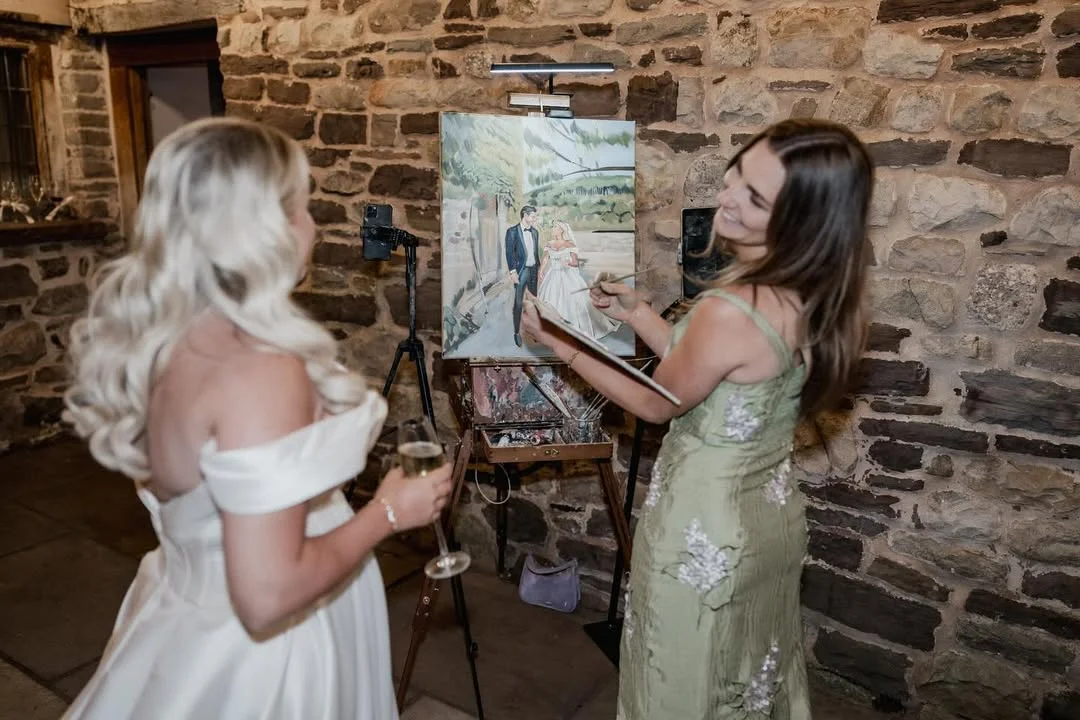
Do you love to paint? Have you ever thought about doing it for a living? You can. More couples than ever want a live painter at their wedding. They want a beautiful piece of art made in front of their guests, and they are happy to pay well for it.
This guide shows you how to turn your talent into a real career. We will cover what you can earn, which styles sell, how to price your work, the kit you need, and how to land your first booking. Most of it is about live wedding painting, the most popular way to earn as a wedding artist today.
One honest note first. Being a great painter is only part of the job. The rest is skill with people, planning, and running a small business. And a quick word on who we are. We are the team behind The Wedding Painters, and we are not painters ourselves, so we will not pretend to teach you how to hold a brush. You know your craft far better than we ever could. What we know inside out is the business side: how to get seen, how to price your work, and how to fill your order book. That is what this guide is really about.
What Can You Earn?
In the UK, what a live wedding painter charges depends on your skill and the type of paint you use. On our platform, live painters start at £950 for one wedding. That is our floor, because we know the work is worth more. Here is a rough guide as you grow:
- Just joining: £950 to £1,200 for one wedding.
- Well known and skilled: £1,500 to £2,200 for one wedding.
- Truly good: £2,200 or more, just to start. Once your skill and name grow strong, £2,200 stops being your top price and becomes your starting price. The best artists go well beyond it.
Book 25 weddings a year at £1,500 each and that is £37,500. It can start as a side income and grow into a full time job. For help setting your rates, read our guide on how to price your art.
In the USA, prices tend to run higher. Couples there often book larger canvases and richer scenes, with live paintings running from around $3,750 for a simple couple scene, to $6,350 for a fuller setting, to $8,000 and up for a large, grand piece. Destination weddings are a big chance for US artists. Couples marrying away from home often want a painter who can travel with them, and these bookings pay more because they cover your skill, your time, and your travel. Pack your kit, and one wedding can become a few days of paid work in a lovely place.
What About Wedding Illustrators?
Not every wedding artist works with a canvas and easel. Some are wedding illustrators, drawing guests and couples in a quick, lively style, often live on the day. The work is faster, the kit is lighter, and the pay is lower. Most illustrators earn between £500 and £1,000 for a wedding, and start at £450 on our platform. A live painter usually earns more per wedding, so if money is your main goal, painting is the stronger path. That said, illustrator prices are rising as more couples discover this kind of art. If drawing is more your thing, it is a lovely way to be part of someone’s big day.
Which Style of Art Sells Best?
Couples do not value every style the same way, and what we see may surprise you.
Art that clearly looks like a painting tends to win more bookings. We mean work where you can see the brush strokes and the artist’s hand. It is full of skill and detail, but no one would mistake it for a photo, and couples can tell at a glance that a real person made it with care.
Super realistic art, the kind that looks almost like a photograph, is still very much in demand and takes huge skill. But if this is your style, the burden of proof sits with you. Because of worries about AI making fake images, couples will not simply take a well-cropped photo of a stunning piece at face value. You have to show, beyond doubt, that the work is yours. That means video: you painting in the studio, you speaking to camera, saying hello and talking about yourself and your process. Let couples see the real person behind the brush. A painting that obviously looks like a painting carries some of that proof in the brush strokes themselves. Hyperrealism does not, so you have to supply it.
One style to avoid for weddings is abstract art. This is no knock on it. Abstract work is a fine art form with its own place in the world. It is just not what couples want on their big day. They do not want to look like a triangle or a square. They want to see themselves.
What works best is real, life-like art with a painter’s touch, and the magic is in the personal touches. Be creative with the background. Think about who the couple are. Is there a hobby, a place, or a small detail that makes them them? Weaving that in turns a nice painting into their painting. One touch that moves couples deeply is including a lost loved one, someone who has passed but who they wish could have been there. To paint that person into the scene is a gift beyond price, and something a camera could never do. If a couple mentions this, handle it with care. Our guide on honouring a loved one at a wedding is a good read.
How to Price and Package Your Work
Here is a common mistake. Artists price by the size of the canvas: bigger canvas, bigger price. That feels simple, but it is usually wrong.
The real driver of price is detail. A simple painting of just the couple takes less time and skill than one full of guests, flowers, and the whole venue behind them. The more detail, the more the piece is worth. Size and detail are linked, though. If a couple wants a full background or other guests in the scene, you need a bigger canvas to fit it all in without looking crowded. So ask how much detail they want first, then choose the size to match. Detail leads, size follows.
One more thing people forget to price in: the wedding day is not the end of the work. Many artists take the piece back to the studio afterwards to add fine detail and finish it properly. That studio time is real hours, so make sure your price covers it. A couple is not just paying for the day. They are paying for the finished piece that arrives weeks later.
Build Your Skill and Your Style
The better you paint, the more work you will get. Take time to learn your craft, and above all find your own style. A style that is truly yours helps you stand out, and it lets you get faster and better because you paint the same way each time. The more you paint, the more sure of yourself you become, and that calm shows in your work.
Show Your Work With a Portfolio
A portfolio is a set of your best work that clients can look at before they book you. You do not need wedding paintings to start. Portraits, sketches, or any art you have made will do. Clients want to see two things: that you are skilled, and that your style feels right for them. Keep it fresh, swapping older work for your newest and best pieces as you improve.
The Kit You Need
A quick and honest word before the list. We, Huw and Jack, the founders of The Wedding Painters, are not artists ourselves. So it would be wrong of us to tell you exactly which kit to buy or which make is best. Every artist has their own preferences, and yours will differ from the next painter’s. What we can do is give you a rundown of the sort of thing you will typically need, so nothing gets left at home. You do not need everything at once, and your kit will grow as you take on more work. But most artists find they need:
A portable easel. Get one that folds away so it is easy to carry and set up, and make it sturdy. If a guest bumps into it, your painting should not fall over.
A surface to paint on. Most artists use canvas because it looks great, holds detail, and travels well. Paper works too. Bring a size that suits the wedding.
Paint. For live weddings, most use acrylic or watercolour because they dry fast. Bring a wide range of colours to mix on the day.
Brushes. Bring a variety, from fine detail brushes to wide ones for backgrounds. Look after them and they will last for years. Our guide on brush care shows you how.
A palette. For mixing your shades, shadows, and highlights. Most are small and easy to carry.
Cleaning supplies. Wipes, a cloth, and water, or the right solvent for oils. This keeps your kit clean and stops spills from staining the venue, which could cost you money.
Good lighting. Venues are often dark. A battery powered LED lamp helps you see true colours. If you cannot see the colour of the dress, you cannot paint it.
Fast drying help. Your painting must be dry enough to move by the end of the night. A fast drying medium helps with oils; a stay wet palette keeps acrylics fresh while you work.
Business cards. A cheap way to spread the word. Keep a small stack by your easel, since guests love watching a painter and some may want to book you next.
Working Fast on the Big Day
The thing new artists fear most is running out of time. You will have around five to seven hours. Here is how the best painters handle it.
Prep before you arrive. Do not start on a plain white canvas. At home, cover it with a warm wash of colour first. It calms your nerves and makes your other colours pop.
Use photos to help. Do not paint people while they move. Take a few clear photos of the big moments, like the first kiss or first dance, paint from those, and glance up now and then to catch the mood.
Push through the messy middle. Every painting looks rough about halfway through, which is exactly when guests watch you most. Stay calm, smile, and keep going. It always comes together.
The Boring but Vital Stuff
Nice venues in places like London and the Cotswolds will not let you in without two things.
Public liability insurance covers you if a guest trips over your easel or gets hurt. You must have it.
PAT testing is a safety check for anything you plug in, like your lamp. Many venues ask for proof.
These may feel dull, but they mark you out as a true professional. See how our verified artists present these credentials to win trust.
How to Get Your First Booking
You do not need a fancy website yet. You need proof that you can do the job. But here is the question we get asked most: how do you show a couple you can paint their wedding when you have never painted a wedding? You need wedding art to get wedding work, but you need wedding work to make wedding art. Here is how to break the loop.
Option one: paint a real wedding. Ask a friend or family member who is getting married if you can paint at their day, for free or just the cost of materials. In return you get photos of you at work and a shot of the final piece. This is the strongest proof, because you really were there, live. It becomes the foundation of your portfolio. For more, read our guide on getting your first wedding client.
Option two: paint from photos. Build up more work by painting wedding scenes from photos of friends’ or family weddings. Some artists even paint famous couples to show their skill, though it is usually clear you were not there, so it does not prove you can work live. The exception is if you truly know them, in which case photos of you together are worth their weight in gold.
Show the person, not just the art. A couple is not only buying a painting. They are buying you. On the day you become part of their wedding, entertaining guests and charming the room. The art is the keepsake; you are the experience. So fill your portfolio with warm, smiley photos of you at work, having fun. No wedding yet? Show it in your studio instead, holding your work. If you once painted a piece for a friend from an old wedding, photograph the moment you gave it to them and get a shot of you both together. It shows you and your client are real people, and that human proof builds trust fast. In a world worried about AI, work that is truly made by your own hand is your biggest selling point.
Film the reveal. Record the moment the couple first see their painting. That short clip of their faces is worth more than any advert.
Keep Going
Turning your passion into a career is not easy. It takes time, and the trick is not giving up when things feel slow. You might work for weeks with no bookings, then land a run of them all at once. It can turn around that fast. Want to know what sets the winners apart? Our guide on the traits of a successful artist is a great next read.
How to Get Onto Our Platform
If you want to join The Wedding Painters, here is how to give yourself the best chance. We vet every artist with care, because couples trust us to send them real, talented people. When you apply, we have a chat with you and take a good look at your portfolio, checking not just that you can paint but that you are a real, working artist.
One big thing we look for is a portfolio built up over time. A collection grown month by month tells a far better story than one thrown together in a weekend. So before you apply, have an Instagram full of your work at the very least, and ideally a simple website too. The stronger those signals, the faster you will be welcomed on. Thin ones tend to slow the process down.
Let Us Do the Hard Part
You could spend two years working out marketing, websites, and how to find couples. Or you could let us do it for you. At The Wedding Painters, we handle the admin, the contracts, and the boring stuff so you can focus on what you love: painting. We have already brought in over £500k in bookings for our artists.
Ready to turn your talent into a real career? Join our roster of wedding artists today.

